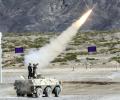
The Chinese military Thursday declined to comment on the performance of China-made weapons used by Pakistan in the recent conflict with India.

India's National Security Advisor Ajit Doval is expected to attend a major security meeting in Moscow next week, organized by Russia's Security Council. Doval is invited for the 13th international meeting of high representatives for security issues, taking place from May 27-29. The meeting, chaired by Sergei Shoigu, Secretary of the Security Council of the Russian Federation, will see participation from over 150 countries and international organizations. Pakistan's NSA, Lt Gen Asim Malik, is also expected to attend the meeting, leading to speculation of a possible face-to-face meeting between the two NSAs amidst heightened tensions between India and Pakistan following the Pahalgam attack and subsequent retaliatory actions.

The city received about 104 mm of rainfall in the last 24 hours, inundating many low-lying areas and leading to traffic pile-up, prompting the BJP to launch a scathing attack on the ruling Congress.

The recent conflict between India and Pakistan was among the issues figured during a phone call between Russian President Vladimir Putin and US President Donald Trump, according to a Kremlin aide.
A top American military commander has said that the US is watching the situation very closely after Indian military strikes on terror targets in PoK and Pakistan's Punjab province. The United States Indo-Pacific Command (USINDOPACOM) is one of six geographic Unified Combatant Commands of the United States Armed Forces, headquartered in Hawaii. Earlier on Wednesday, US President Donald Trump said he wants India and Pakistan to stop the conflict, saying if he can do anything to help, he will be there. Foreign Secretary Vikram Misri told reporters in New Delhi on Wednesday that the Indian military carried out a measured, non-escalatory, proportionate, and responsible strike to dismantle terrorist infrastructure in Pakistan to deter and to pre-empt any further terrorist strikes.
Trump has a major decision to take in coming days -- specifically, how to rescue Israel from the attritional war that lies ahead, points out Ambassador M K Bhadrakumar.
United States President Donald Trump will host Pakistan Army chief Asim Munir for lunch at the White House on Wednesday.
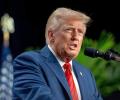
Trump said that leaders in India and Pakistan are "great leaders" and "they understood, and they agreed, and that all stopped".
'Unlike the surgical strikes and the Balakot air strikes across the LoC, we have gone further inside Pakistan and raised the bar of escalation.'
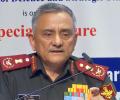
Pakistan's decision to talk to India on May 10 stemmed from realisation that it will suffer more if its operation continues, Gen Chauhan said.

Asserting that India will not tolerate any 'nuclear blackmail', Prime Minister Narendra Modi on Monday said operations against Pakistan have only been kept in abeyance and the future will depend on their behaviour.
The Indian Air Force on Sunday said it has successfully executed its assigned tasks with precision and in line with national objectives during Operation Sindoor.
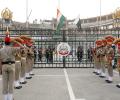
Pakistan's Foreign Office spokesperson Shafqat Ali Khan said on Friday that the ceasefire with India was holding and the country is committed to it. He also said that Pakistan is committed to making the ceasefire hold and de-escalation succeed, and then engagement to lead to stability and resolution of issues. Khan said that the two militaries have a channel of communication through the Directors General of Military Operations, through which they are working for de-escalation, in terms of the movement of troops. He added that Pakistan remains committed to the ceasefire announced on May 10 and lately, both sides have taken steps for de-escalation and return of stability.
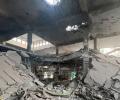
In a strong retaliation to the Pahalgam massacre, India's armed forces early Wednesday destroyed nine terror sites including that of Jaish-e-Mohammad and Lashkar-e-Taiba in Pakistan and Pakistan-occupied Kashmir (PoK) using deep strike missiles in a 25-minute-long 'measured and non-escalatory' mission.

The Border Security Force (BSF) launched "Operation Sindoor" in retaliation to unprovoked firing and shelling by Pakistani Rangers along the International Border (IB) in Jammu. BSF troops destroyed three terrorist launch pads and targeted 76 Pakistani border outposts and 42 forward defence locations. The BSF action came after Pakistan launched heavy firing and shelling on 60 Indian posts and 49 forward positions, reportedly providing cover for an attempted infiltration by 40-50 terrorists.

India's Foreign Secretary Vikram Misri said on Thursday that the choice of de-escalation is with Pakistan, as India only responded to the April 22 Pahalgam terror attack, which killed 26 people. He added that Pakistan has been escalating the situation with cross-border terrorism against India for decades.
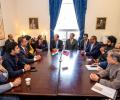
The lawmakers also hailed the strong strategic partnership between India and the US during a meeting with an all-party delegation led by Congress MP Shashi Tharoor, who briefed them on the cross-border terrorism faced by India and the country's strong and resolute stance in the fight against terror.

Interacting with the Indian diaspora in Kuala Lumpur, Banerjee said, "We have been in talks with them (Pakistan) for decades, despite changes in various paradigms and governments. But one thing remains constant, the conflict with Pakistan."

PSL postponed on advice PM Sharif: PCB

A senior leader of the ruling Pakistan Muslim League-Nawaz (PML-N) on Wednesday claimed that the military operation against India was designed under the supervision of the party president Nawaz Sharif.

The Director Generals of Military Operations (DGMOs) of India and Pakistan on Monday deliberated on various aspects of the May 10 understanding reached between the two sides on cessation of hostilities.

Modi, who visited Cyprus in the first leg of his three-nation visit, reiterated India's support for Cyprus's unity and for a peaceful resolution of the Cyprus Question based on UN Security Council resolutions, international law, and the EU Acquis.
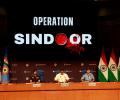
The logo for India's Operation Sindoor, which has captured the imagination of millions, was designed by two Armymen. The operation, a decisive military action against terror camps in Pakistan and Pakistan-Occupied-Kashmir, was launched in response to the Pahalgam massacre. The logo, featuring a bowl of vermilion, has become a powerful symbol of India's resolve against terrorism.

According to the sources, the claim suggests that the attackers may have compromised personal information related to defence personnel, including the login credentials.
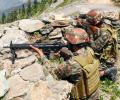
For the first time, the Data Security Council of India assembled a joint task force to source threat intelligence at the origin and ensure coordinated action across the cybersecurity spectrum.
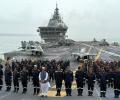
In an interaction with naval warriors on board aircraft carrier INS Vikrant off Goa, Singh sent a stern warning to Islamabad saying India will not hesitate to use the methods to deal with terrorism that Pakistan cannot even think of.
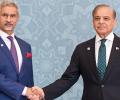
Addressing a special 'Youm-e-Tashakur' event at the Pakistan Monument in Islamabad, Shehbaz said that India and Pakistan fought three wars and got nothing.
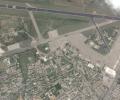
Pakistan's Prime Minister Shehbaz Sharif admitted that India's ballistic missiles hit Nur Khan Airbase and other sites on May 10, a rare acknowledgement that contradicts Pakistan's usual stance of denial when it comes to Indian military action.
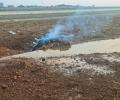
Dar's statement, echoed by another federal minister, came as the Indian and Pakistani militaries targeted each other's installations using missiles in the last more than 12 hours, further escalating the already tense conflict situation.

"Fearless in unity. Boundless in strength. India's shield is her people. There's no room for terrorism in this world. We're ONE TEAM! Jai Hind," Tendulkar posted

National Security Advisor Ajit Doval on Monday emphasised the need to counter terrorism in all its forms for overall regional peace and stability during a meeting with Chinese Foreign Minister Wang Yi in Beijing.
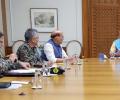
India has called Pakistan's nuclear bluff with Operation Sindoor and sent a psychological message to state-sponsored terrorists: nobody is untouchable and no place in Pakistan is safe for you, government sources said on Sunday.

Amid Indian strikes, PCB in huddle to decide whether PSL should continue

'Militarily, it risks escalating tensions with Pakistan, potentially triggering conflict due to Pakistan's heavy reliance on the Indus.'
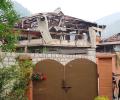
Army spokesman Lt Gen Ahmad Sharif Chaudhry in a media interaction said at least 26 people were killed and 46 injured in the missile strikes on cities in Punjab and PoK. "The six locations that India attacked last night... Pakistan lost 26 people and 46 were injured," he said.

So far, most of the injured have been released. Currently, 106 people are being treated in hospitals, and another 149 are being treated in the emergency room.
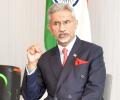
When asked whether both armies talked to each other, initiated by the Pakistani army, Jaishankar said, "Yes, we have a mechanism to talk to each other as a hotline. So, on the 10th of May, it was the Pakistani army which sent a message that they were ready to stop firing, and we responded accordingly."

The post further read that "at a moment of heightened regional turbulence", President Trump "demonstrated great strategic foresight and stellar statesmanship through robust diplomatic engagement with both Islamabad and New Delhi," Dawn reported.

India has secured international support in its fight against terrorism, with Russia, Japan, and the United Arab Emirates expressing solidarity and a commitment to working together to combat the threat. This follows a recent terrorist attack in Pahalgam, India, which claimed 26 lives. Multi-party parliamentary delegations from India briefed the leaderships of these countries on Operation Sindoor, India's response to the attack, and discussed ways to enhance cooperation in counter-terrorism and combating radicalism. These developments highlight the growing global consensus against terrorism and the importance of international collaboration to address this shared challenge.
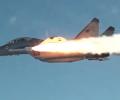
'For weeks, months and years, it would continue to be debated if India should have pushed the early advantage and decapacitated Pakistan militarily.' 'India refused to bite the provocatively proverbial bullet and escalate it into a full-fledged war,' notes N Sathiya Moorthy.
 © 2026 Rediff.com - Advertise with us - Disclaimer - Privacy Policy - Sitemap - Feedback - About us - Terms of use - Grievances